MDCAT Biology Cell Structure MCQs 7

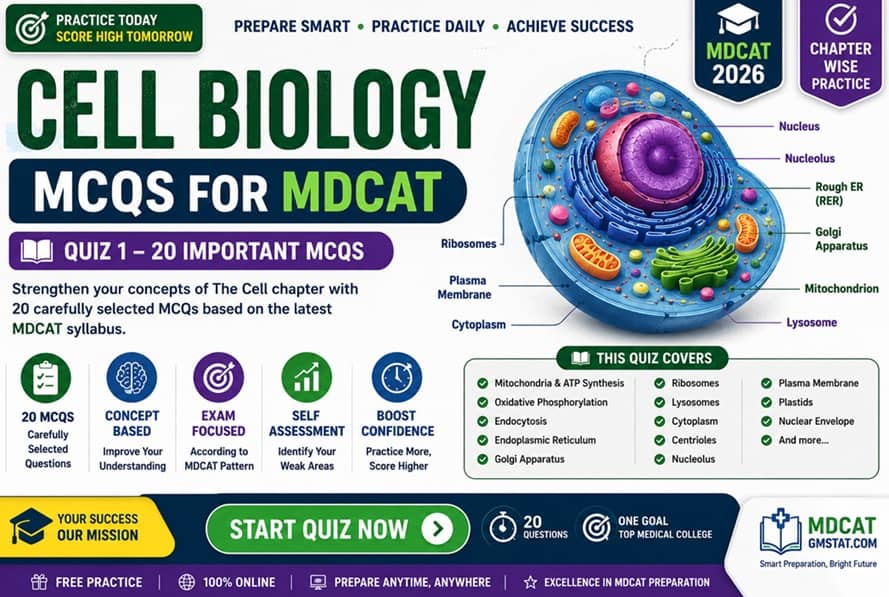
Practice 20 high-yield MDCAT Biology Cell Structure MCQs with detailed concepts. Master PMDC topics including cell organelles, Golgi complex, mitochondrial cristae, and microscope magnification calculations. Let us start with the online MDCAT Biology Cell Structure MCQs now

MDCAT Biology Cell Structure MCQs with Answers

  1. In which of the following is the greatest amount of Deoxyribonucleic acid (DNA) found?
  2. Which of the following statements best describes the fluid mosaic model of the plasma membrane?
  3. Which of the following is/are energy-consuming process(s)?
  4. Which of the following plasma membranes does not have a transport function?
  5. Which of the following is the function of SER?
  6. Golgi apparatus is practically important in
  7. An important function of the Golgi apparatus is the formation of
  8. If 15 $\mu m$ size objects are observed under a light microscope using 5x eyepieces and 10x objective, their magnified image size will be
  9. The ability to distinguish between two separate points/ objects is
  10. The membrane of the ER is
  11. The structure present in a eukaryotic cell but absent in prokaryotic cells is
  12. Among followings which cellular organelle contains circular DNA similar to that found in bacteria?
  13. Membranous units forming a series of continuous and discontinuous cavities in the cell are called
  14. RNA is absent in
  15. The space between the outer and inner mitochondrial membranes is
  16. The inner mitochondrial membrane is compartmentalized into numerous cristae, which
  17. The cisternae break up into vesicles from ——————– of the Golgi complex.
  18. Which organelle is non-membrane-bound and has its subunits assembled inside the nucleolus?
  19. According to the fluid mosaic model, which molecule acts as a “temperature buffer” to regulate cell membrane fluidity in animal cells?
  20. Which of the following organelles contains circular DNA and 70S ribosomes, enabling it to synthesize some of its own proteins?
MDCAT Biology Cell Structure MCQs

Online Zoology MCQs Tests

MDCAT Cell Biology MCQs 6: Cell Structure & Function

Master MDCAT Cell Biology MCQs with 20 essential practice MCQs covering the fluid mosaic model, organelle functions, active transport, and cell membrane mechanisms. Perfect for PMDC MDCAT preparation. Let us start with online MDCAT CELL Biology MCQs:

Online MDCAT CELL Biology MCQS Test with Answers

  • The attachment of ribosomal subunits is controlled by —————— ions
  • According to the fluid mosaic model of the cell membrane
  • Each cell of a frog contains autosomes
  • The nucleus is only visible when the cell is in —————— stage.
  • The free ribosomes of the mitochondria are present in its
  • Two functions of a rough endoplasmic reticulum are to
  • An organelle composed of membranous tubules that synthesizes testosterone is the
  • Prokaryotic cells are different from eukaryotic cells in that prokaryotic cells lack
  • Substances cross the cell membrane more easily when they are
  • Which of the following properties is incorrect for both mitochondria and chloroplasts?
  • Eukaryotic cells are more efficient than prokaryotes because of their internal compartmentalization.
  • Passage through pores in the nuclear envelope is restricted primarily to
  • Which of the following is also called bulk transport
  • Extranuclear DNA is found in
  • According to the fluid mosaic model, the plasma membrane presents
  • What is the most important difference between active and passive cell transport?
  • Which of the following statements best describes the fluid mosaic model of the plasma membrane
  • Which of the following cell organelles produces secretory vesicles?
  • Which of the following moves material against a concentration gradient?
  • What is the sequence of organelles that a secreted protein would have passed through on its journey out of the cell?
MDCAT Cell Biology MCQs

Online Zoology MCQs Test

Cell Biology MCQs with Answers 5

Master “The Cell Structure” chapter with 20 targeted Cell Biology MCQs covering organelles, cell membranes, ribosomes, and prokaryotes. Perfect for self-assessment and exam prep. Let us start with the Online Cell Biology MCQS now:

Cell Biology MCQs with Answers

  1. The unit that specifies the sedimentation rate of a specific particle or molecule in a medium during ultracentrifugation is
  2. Plant and animal cells both have ———-
  3. Polysomes are formed by ————-
  4. Lysosomes are cytoplasmic organelles and are different from others due to their
  5. The approximate diameter of peroxisomes is
  6. Which one of the following is not considered a part of the endomembrane system
  7. Oxidative metabolism is carried out —————– of mitochondria.
  8. The complex of sugar polymers and proteins which are patchily distributed on the plasma membrane of animal cells is called
  9. Which of the following statements is wrong?
  10. The protoplasm of a plant cell is
  11. Which of the following is not characteristic of prokaryotic?
  12. The term “nuclear envelope” is more correct than the term “nuclear membranes” because
  13. Smooth endoplasmic reticulum helps to
  14. The ribosomes are attached to mRNA through ————- ribosomal subunit.
  15. Which is present in both prokaryotic and Eukaryotic cells?
  16. The correct statement about the Golgi complex is
  17. The cisternae break up into vesicles from the
  18. Bacterial cells are prokaryotic in comparison to a typical eukaryotic cell; they would
  19. A cell has mitochondria, ribosomes, smooth and rough ER, and other parts. Based on this information, it could not be
  20. Eukaryotic ribosomes are composed of an almost equal amount of —————— and proteins
Cell Biology MCQs with Answers

Online MCQs about Zoology

Cell Structure and Function

Test your knowledge of Cell Structure and Function with this comprehensive MDCAT Biology Quiz containing 20 carefully selected multiple-choice questions. This MDCAT Biology quiz covers essential topics including prokaryotic and eukaryotic cells, plasma membrane, cell wall, ribosomes, Golgi apparatus, endoplasmic reticulum, lysosomes, mitochondria, plastids, cytoskeleton, plasmodesmata, glycoproteins, glycolipids, protein synthesis, lipid synthesis, cell secretions, and other important cellular organelles.

Each MCQ is designed according to the latest MDCAT syllabus to help medical students strengthen conceptual understanding, improve problem-solving skills, and prepare effectively for MDCAT, NUMS, and other medical entrance examinations. Practice regularly to identify weak areas, build confidence, and maximize your score. Let us start with the online Cell Structure and Function Quiz now.

Cell Structure and Function (MDCAT Biology Quiz)

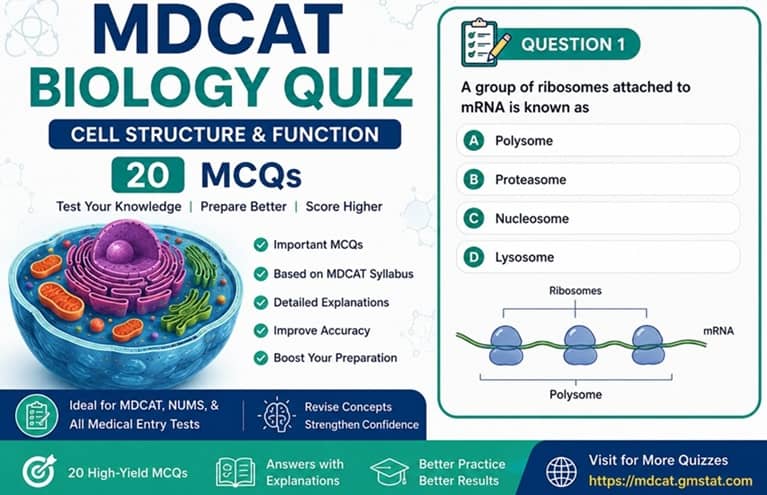
  1. A group of ribosomes attached to mRNA is known as
  2. Palade studied
  3. Which of the following is responsible for the mechanical support, protein synthesis, and enzyme transport
  4. The intake of liquid material by the plasma membrane is termed as
  5. The prokaryotic cell wall is made up of
  6. The amount of lipids in the plasma membrane is about
  7. Which one of the following structures is an organelle within an organelle
  8. An important site for the formation of glycoproteins and glycolipids is
  9. Which one of the following has its own DNA?
  10. Plant cells and animal cells differ in that
  11. Which of the following structure-function pairs is mismatched?
  12. Eukaryotic and prokaryotic cells share all of the following features except.
  13. A major site for synthesis of lipids is?
  14. The Golgi complex plays a major role?
  15. Plasmodesmata are
  16. The cytoskeleton is made up of
  17. What is true about ribosomes?
  18. Ribosomal RNA is actively synthesized in
  19. Which one of the following cellular parts is correctly described?
  20. Which of the following is concerned with cell secretions?
Cell Structure and Function

Try General Knowledge Quiz

MDCAT Biology Cell Structure & Transport MCQs 3

Master cell membrane transport, organelle functions, and membrane biology with this 20-question MDCAT Biology Cell Structure Practice Quiz. Test your knowledge on active transport, peroxisomes, and facilitated diffusion with solved answers. Let us start with the online MDCAT Biology Cell Structure & Transport MCQs Test.

MDCAT Biology Cell Structure & Transport MCQs with Answers

  1. Which of the following criteria does not relate to facilitated transport?
  2. Select the correct statement from the following regarding the cell membrane
  3. Na+/ K+ pump is associated with
  4. What is correct about the movement of substances across the membrane in facilitated diffusion?
  5. The energy necessary for active transport across the cytoplasmic membrane is believed to come from
  6. The cell membrane is composed primarily of
  7. Transport proteins are required for
  8. The basic structure of the plasma membrane is provided by
  9. The organelle involved in detoxification of drugs and poisons in the liver cells is
  10. Peroxisomes are approximately ——————- in diameter.
  11. The cell membrane is chemically composed of
  12. Which of the following is not found in animal cells?
  13. Movement of materials against concentration gradient through plasma membrane is termed as
  14. Biological membrane includes
  15. The difference between active transport and facilitated diffusion is that in the latter
  16. Which of the following is not found in most of the plant cells?
  17. The substances that cannot cross the cell membrane more easily are
  18. Which statement is not true of membrane phospholipids?
  19. Which of the following is related to glycosylation of protein?
  20. DNA is present in
MDCAT Biology Cell Structure & Transport MCQs 3

Try Zoology MCQs Test